
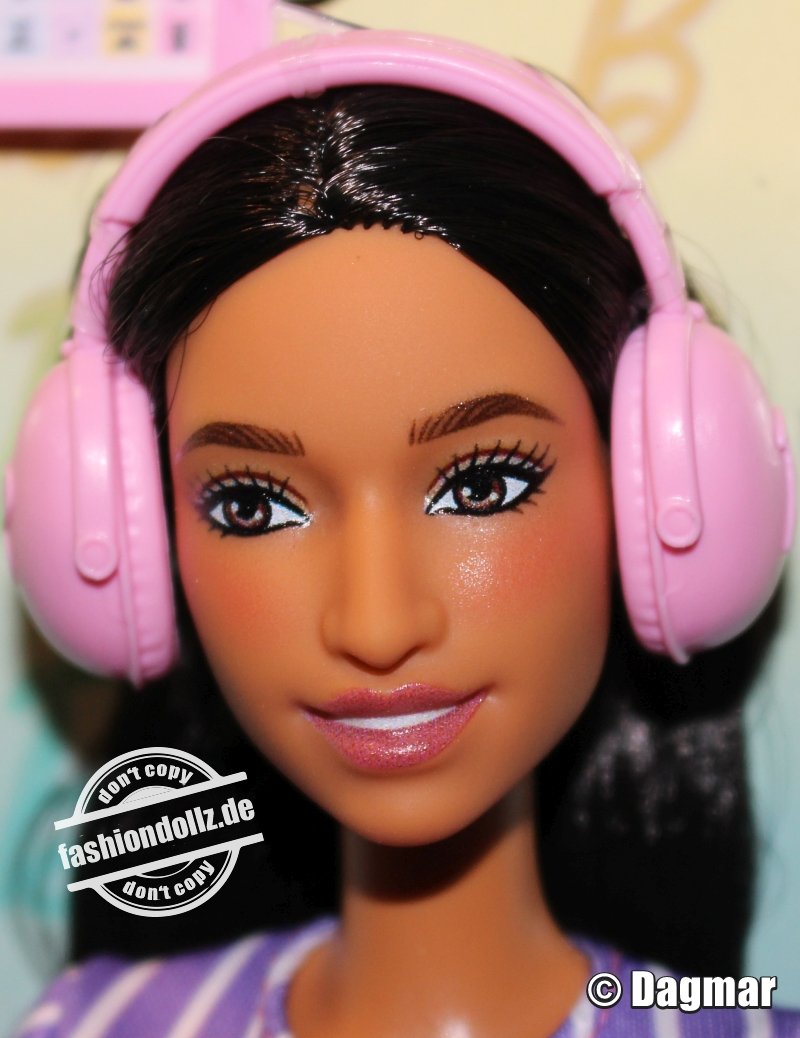
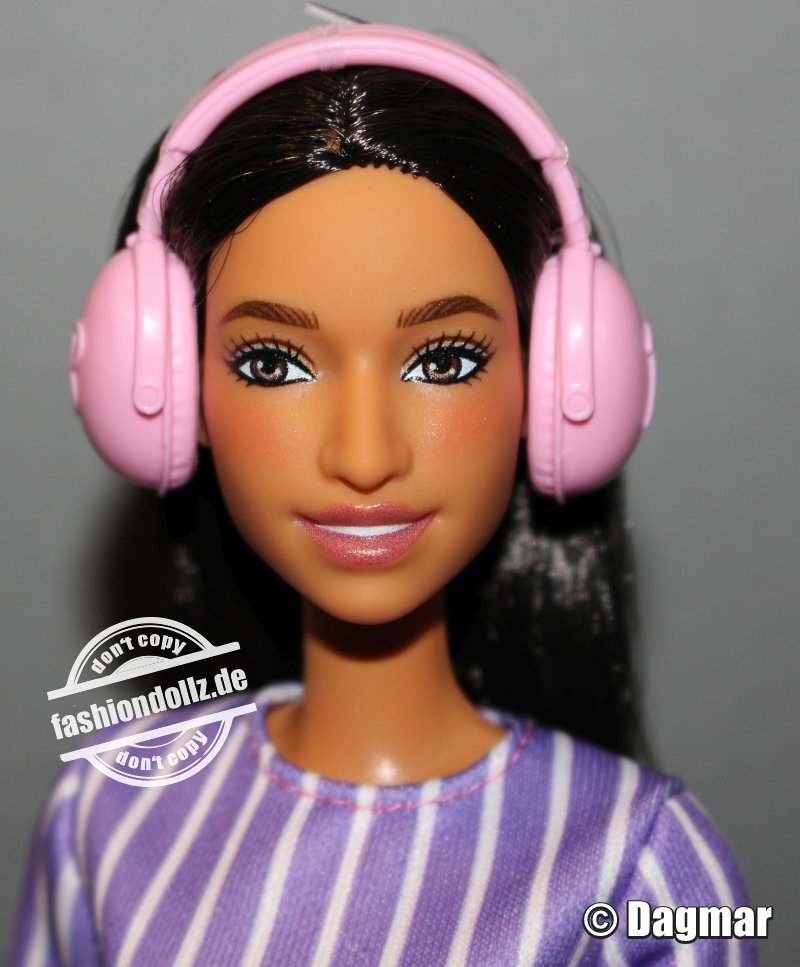
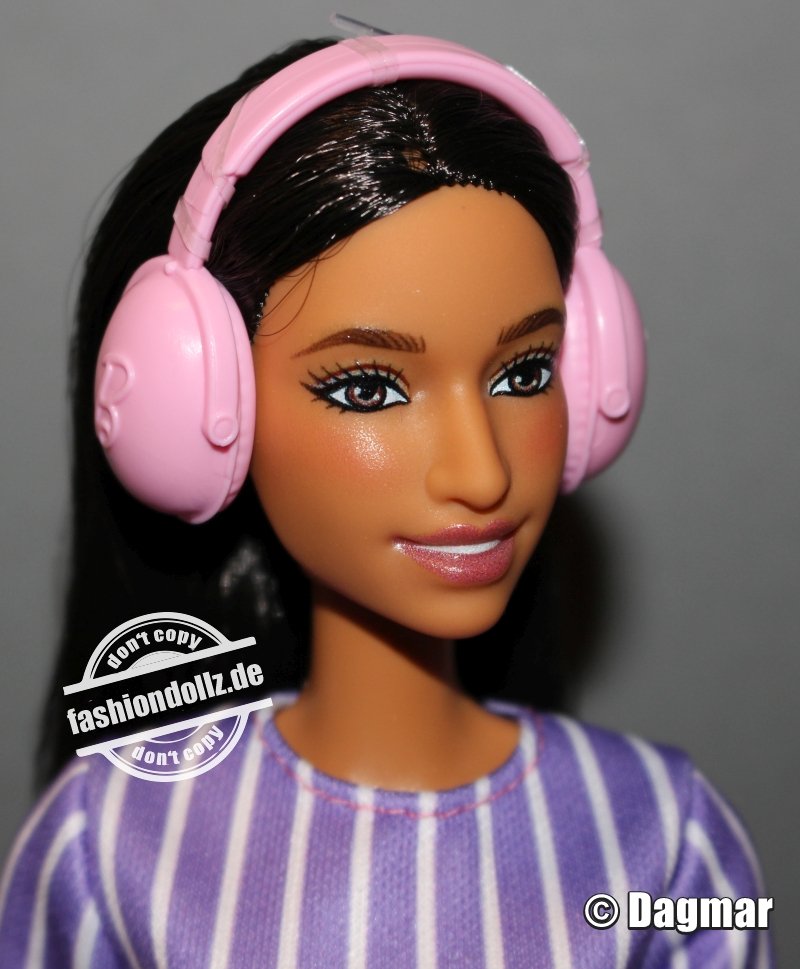
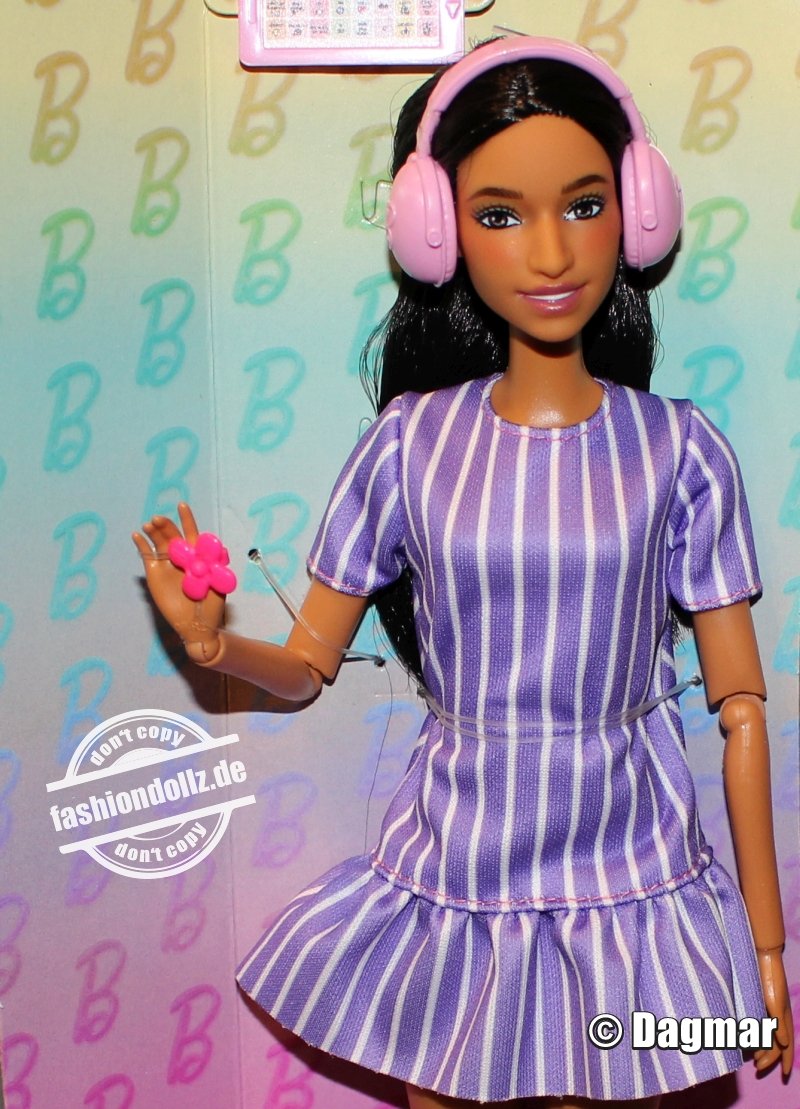
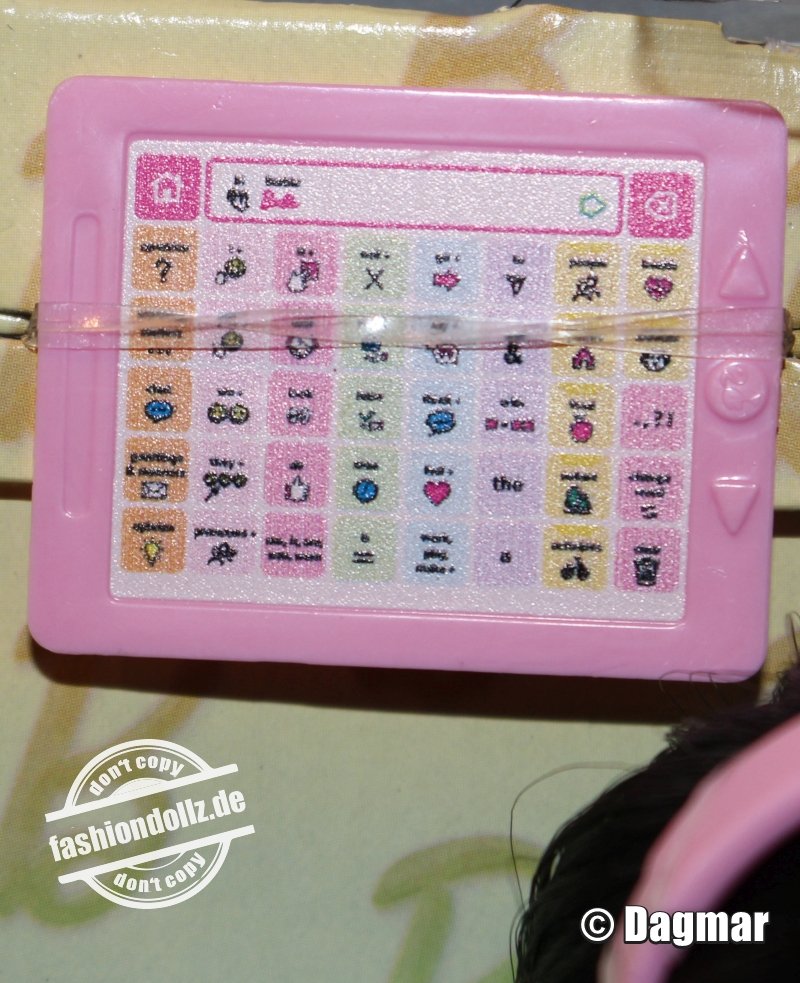
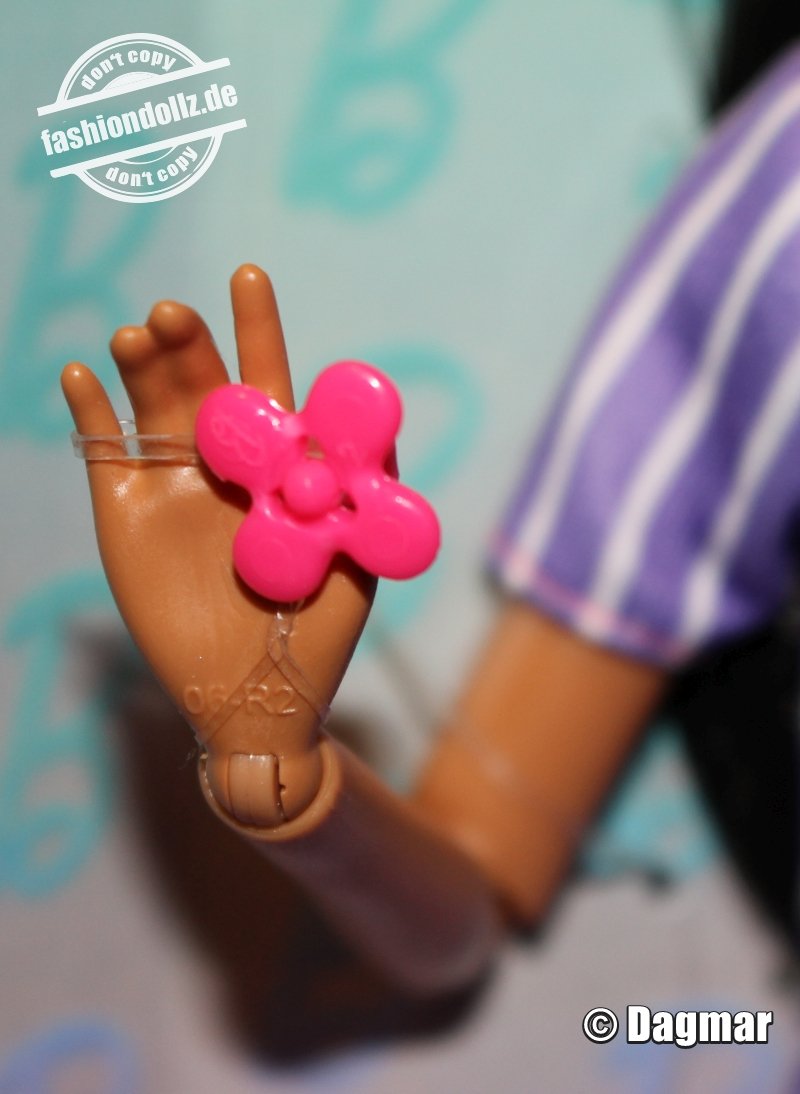
According to Mattel, the doll’s development took over 18 months and was carried out in partnership with ASAN, a non-profit organization for the rights of people with autism. Various features associated with the autism spectrum were incorporated into the design. For example, her gaze is slightly sideways and downward to reflect how some people avoid direct eye contact. But this aspect is only noticeable if pointed out. The doll got two Accessories for stress-reduction – a pink finger-clip fidget spinner and noise-canceling headphones – additionally she got a tablet displaying AAC communication symbols. To allow her to use these aids, the Barbie is designed with jointed elbows and wrists, but her knees and feet are not jointed.
The clothing also takes the neurodevelopmental condition into account: The Barbie wears a loose-fitting A-line dress with short sleeves and a flowing skirt, paired with flat shoes for stability and comfort.
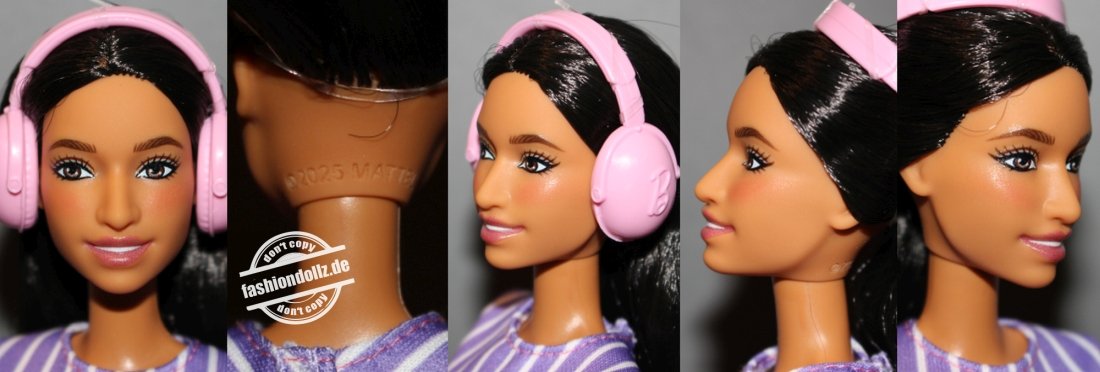
Headmark: © 2025 MATTEL
DIm Januar 2026 stellte Mattel mit der aktuellen Fashionistas Wave eine Barbie mit Autismus vor. Sie soll die autistische Gemeinschaft in unserer Welt repräsentieren und würdigen. Ihr Gesicht ähnelt ein wenig dem Leila Facemold von 2022, ihre Nase ist aber etwas breiter.Die Entwicklung der Doll dauerte laut Mattel über 18 Monate und erfolgte in Partnerschaft mit ASAN, einer gemeinnützigen Organisation, die sich für die Rechte von Menschen mit Autismus engagiert. Bei der Gestaltung wurden verschiedene Merkmale integriert, die mit dem Autismus-Spektrum verknüpft sind. So wurde der Blick leicht seitlich und nach unten ausgerichtet, um zu zeigen, dass manche Menschen direkten Augenkontakt vermeiden. Dieser Aspekt ist allerdings nur erkennbar, wenn man drauf hingewiesen wurde. Zu den Accessoires gehören zwei Hilfsmittel zur Stressreduktion – ein pinkfarbener Fingerclip-Fidget-Spinner und ein Noise-Cancelling-Kopfhörer – sowie ein Tablet mit Symbolen der AAC-Kommunikation. Damit sie ihre Hilfsmittel einsetzen kann, wurde die Barbie mit beweglichen Ellbogen und Handgelenken gestaltet, die Knie / Füße sind jedoch ohne Gelenke.
Auch bei der Kleidung wurde der neurologischen Entwicklungsstörung Rechnung getragen: Die Barbie ist in ein locker sitzendes A-Linien-Kleid mit kurzen Ärmeln und fließendem Rock gekleidet, kombiniert mit flachen Schuhen für Stabilität und Komfort.
[Werbung:] Find the doll on ebay…
ebay.com I ebay.de I ebay.at I ebay.ch I ebay.nl I ebay.fr I ebay.it I ebay.es I ebay.ie I ebay.co.uk I ebay.ca I ebay.com.au I ebay.ph I ebay.com.my I ebay.com.sg I ebay.com.hk I
Fashiondollz setzt Affiliate-Links zu thematisch passenden Produkten bei ebay und amazon ein. Wenn du über die Links einen Kauf tätigst, erhalten wir eine kleine Provision, ohne dass dir zusätzliche Kosten entstehen.
Fashiondollz uses affiliate links to thematically relevant products on eBay and Amazon. If you make a purchase through the links, we receive a small commission at no additional cost for you.
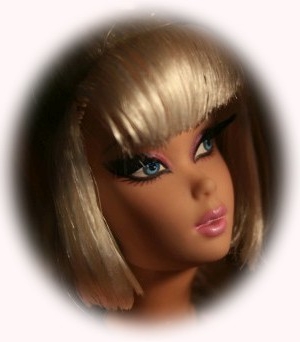

You Are Aware Not All Autistic People Have A Face Like This, Right? Maybe Rename It To „Modifed Leila Mold“ Or Something Similar, As The Name „Autistic Mold“ Has Connotations Of Saying All Autistic People Have A Face Like This. Thanks! 🙂
Sorry, if the term „Autistic Barbie Face“ hurts your feelings. Yes of course not all autistic People have a face like this. Simply because it’s a plastic doll face. But it is a facemold, Mattel developed to realize an autistic „looking“ doll. If you ask me, I can’t see any sign of autism at this doll, only her accesories do that. But we would like to keep the term to explain with three words for which Barbie it was developed. 🙂
(Reply To Dagmar) I Defintely Agree With Your Statement Saying The Only Thing That Denotes This Doll Is Autistic Is The Accessories! ^^ Personally, I Wish The Accessories Were Sold Seperately, As, Since Autism Isn’t A Physical Disability, Any Barbie Can Be Autistic! I’d Like For A Barbie With A Cuter Face, Such As The TNT Or Steffie Face, To Be Autistic Too ♫
I put „Autistic Barbie“ in quotation marks. I think that makes it clearer that it’s the face mold of the „Autistic Barbie“ and not an „autistic“ face. Which, in my opinion — and I agree with you — doesn’t even exist. And the suggestion of the eyes looking to the side can only be detected with a great deal of imagination.